


The History and Tradition of Kosher Cuisine in Florence
A regional cuisine shaped by Jewish law, migration, and local ingredients
To understand kosher cuisine in Italy, it helps to begin with one essential point: it is not a single, separate national cuisine, but a mosaic of regional Italian food traditions shaped by kashrut, Jewish dietary law, and by the history of Jewish communities across the peninsula.
One of the clearest historical surveys of the subject explains that Italian Jewish food developed through the adaptation of local produce and local recipes to Jewish law, while preserving the memory of communities that flourished in cities such as Florence, Pisa, Lucca, Siena, Livorno, Venice, Ferrara, and Rome. In that sense, Jewish food in Italy is not only about rules; it is also a record of movement, resilience, and belonging.
What makes a cuisine “kosher” in the Italian context
In the Italian case, kosher cooking historically meant adjusting regional food habits to the framework of Jewish law. A key survey notes that cooks often relied on oil or goose fat instead of butter or pork fat, and that the limits on mixing meat and dairy encouraged the development of rich vegetable and dairy dishes that could still feel substantial. The same source underlines the importance of Sabbath and holiday cooking, including dishes prepared in advance and foods designed to be eaten cold.
Current rabbinic guidance for Italy also shows that local custom matters: for Pèsach, for example, the official 2026 Italian list states that, according to Italian and Sephardic tradition, rice and legumes are permitted, provided they are checked carefully in advance. That detail is small but important, because it shows that Italian Jewish food is shaped not only by general Jewish law, but also by the specific minhagim of Italian communities.
Florence: a Jewish history that begins early and changes with Medici policy
The Florentine story is especially important because the city’s Jewish history is old, layered, and closely tied to political change. Official Jewish heritage material states that Jews were present in Florence from Roman times and that the Medici invited Jewish moneylenders to the city as early as 1430. Later, under Cosimo I de’ Medici, a ghetto was created in 1570–1571, in the area of what is now Piazza della Repubblica.
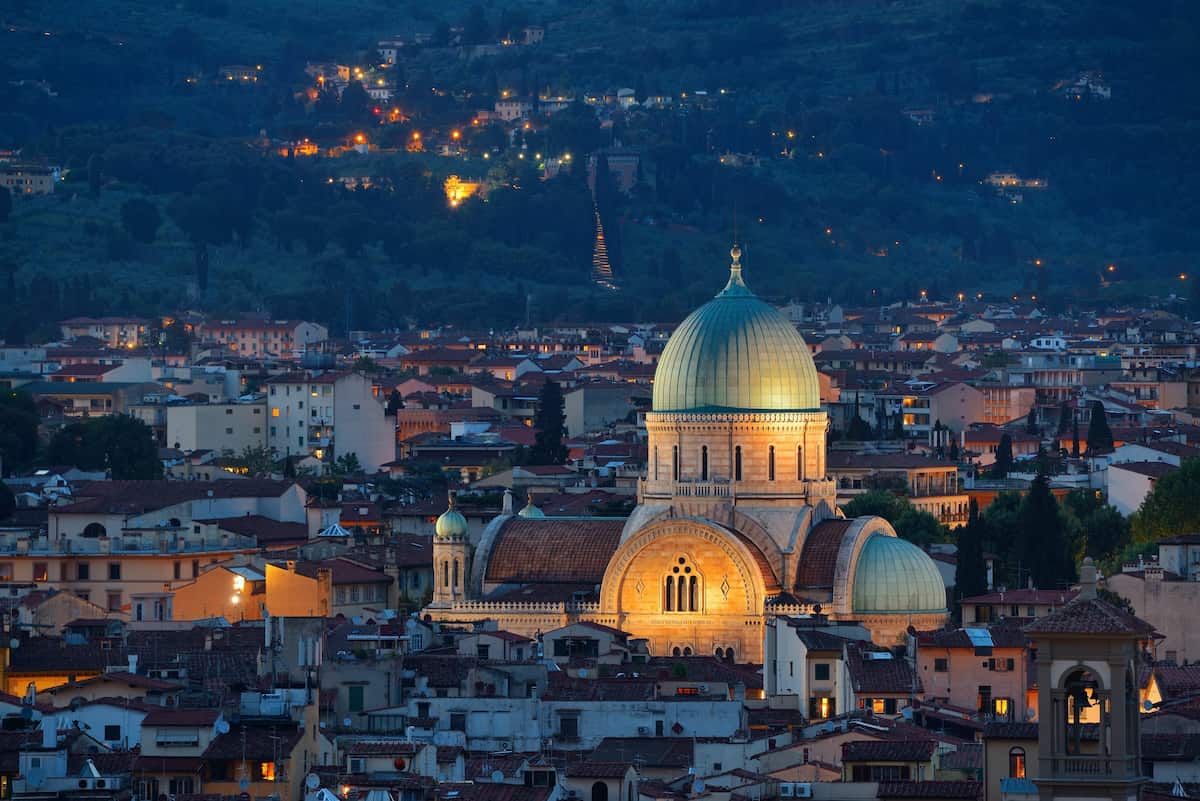
Local cultural material describes that ghetto as a small enclosed urban world with synagogues, schools, baths, shops, and internal social life. Florence’s Jewish geography changed again after emancipation in the nineteenth century, culminating in the construction of the city’s monumental synagogue, completed in 1882 in the Mattonaia area, far from the old ghetto and conceived as a visible sign of integration and equal rights.
Why Florence matters for the history of kosher food
This urban history matters because food follows settlement patterns. In Florence, as elsewhere in Italy, Jewish cooking developed within a local Tuscan pantry but under Jewish religious rules and inside a distinct communal structure. A major historical survey of Italian Jewish cuisine specifically preserves Florentine-style references in Jewish recipe memory, including baccalà e spinaci all’uso fiorentino and a Tuscan sweet spinach-and-almond tart.
The same survey also argues that Jewish cooks helped spread the taste for vegetables such as aubergines, artichokes, and spinach in central and northern Italy, while adapting local ingredients to Jewish dietary practice. In Florence, this meant a cuisine that sat naturally within the broader Tuscan food world, olive oil, greens, legumes, fish, pastry, and seasonal produce, but interpreted through Jewish law and holiday rhythm.
A cuisine of seasons, vegetables, oil, and ingenuity
When people imagine Jewish food in Italy, they often think first of Roman dishes, but Florence and Tuscany reveal another side of the tradition: one more closely tied to the agricultural logic of central Italy. The historical record shows how Italian Jewish cooks often leaned into vegetable dishes, legumes, fish, fritters, and preparations that could be cooked in advance for Shabbat.
That pattern fits Tuscany especially well. It is a region built on olive oil, beans, bread, greens, artichokes, and modest but flavourful seasonal cooking. In Florence, kosher food therefore did not emerge as something alien to Tuscan cuisine; it emerged as a parallel Tuscan kitchen, one that shared the land’s ingredients while giving them a distinct ritual and legal framework.
Tuscany beyond Florence: Livorno and Pitigliano widen the picture
To understand Jewish food in Florence fully, it also helps to look at the wider Tuscan map. Livorno is crucial because its Jewish community grew under the Livornine, the laws issued from 1593 onward that invited merchants, especially Jews exiled from the Iberian world, to settle in the free port with broad protections and without a ghetto. Official heritage material notes that Livorno’s market culture still preserves numerous Jewish products as a testimony to that history.
The broader historical survey of Italian Jewish cuisine links Livorno directly to dishes such as cacciucco alla livornese and cuscussù livornese, showing how Sephardic, Portuguese, and later North African influences entered Tuscan Jewish food. Further south, Pitigliano, long known as “Little Jerusalem,” preserves the memory of a Jewish quarter, synagogue, and even the old bakery where azzime, or unleavened bread, were prepared. Together, these places show that Jewish Tuscan food was never only Florentine; it was regional, varied, and deeply connected to migration.
The Florentine tradition between Italian rite and Sephardic influence
Florence is also interesting because of rite and identity. Local cultural material describes the city’s monumental synagogue as Sephardic rite, while the broader history of Florence shows centuries of internal change, from early settlements and ghetto life to emancipation and a golden age between the late nineteenth and early twentieth centuries.
That background helps explain why Florentine Jewish food cannot be reduced to one narrow formula. It belongs to the Italian Jewish tradition, but it also reflects Sephardic currents that shaped ritual life, festive practice, and the wider Tuscan Jewish world. The official 2026 Pèsach guidance, which explicitly refers to “Italian and Sephardic tradition” in relation to rice and legumes, is a present-day reminder that these identities still matter in practice, not only in history books.
Typical flavours and dishes in the Florentine-Tuscan Jewish repertoire
What, then, does this cuisine taste like? Historically, it is a cuisine of olive oil rather than lard, of greens and vegetables treated with seriousness, of fish dishes adapted to kashrut, of festive sweets, and of recipes that preserve local accents while remaining recognisably Jewish. In the Tuscan sphere, that can mean Florentine-style salt cod with spinach, sweets built around almonds and vegetables, and a broader repertoire of vegetable, pulse, and cold dishes connected to Shabbat and festivals.
In Livorno, it can extend toward fish stews, tomato-based dishes, and couscous-like preparations that reflect Sephardic and Mediterranean routes. The point is not that Jewish Tuscan cuisine sits outside regional food, but that it expresses Tuscany through a specifically Jewish grammar.
A living heritage, not only a museum topic
This tradition is not only historical. In Florence today, the Jewish Museum inside the synagogue offers a structured account of the community’s history, family life, rituals, and annual festivals, making clear that Jewish life in the city is not a vanished subject but part of Florence’s continuing cultural fabric. At the same time, there is a noticeable modern revival of interest in Italian Jewish food.
A recent institutional transcript introducing food writer Benedetta Guetta describes her as co-founder of what it calls the only Jewish kosher cooking blog in Italy and as a teacher of Italian Jewish food in schools, synagogues, and community centres. That revival matters because it suggests that kosher cuisine in Italy is not being preserved only through archives and museums, but also through recipes, teaching, and contemporary interpretation.
Florence’s place in the broader story
Florence occupies a special place in this story because it represents a bridge. It is not the oldest Jewish food capital in Tuscany, that claim belongs more naturally to places such as Pisa, whose Jewish presence is documented as early as 850, or to Livorno with its free-port cosmopolitanism. But Florence is one of the clearest places where Jewish history, ghetto memory, emancipation, ritual continuity, and local Tuscan food culture meet visibly in one city. Its old ghetto traces survive in the urban memory around Piazza della Repubblica; its nineteenth-century synagogue still defines the skyline; and its culinary heritage survives in scattered but telling recipes that show how Jewish life was woven into the wider Tuscan table.
The history of kosher cuisine in Italy, and especially in Florence, is best understood not as a separate culinary island, but as a deeply rooted Italian regional tradition shaped by Jewish law, migration, and memory. In Florence, that tradition grew under Medici patronage and restriction, survived the ghetto period, adapted after emancipation, and left behind a food culture built on Tuscan ingredients interpreted through Jewish practice. In the wider Tuscan world, Livorno and Pitigliano add Sephardic, Mediterranean, and rural layers that make the regional picture even richer.
What remains most striking is how much this cuisine still says with relatively modest means: oil, vegetables, fish, legumes, festive sweets, and a disciplined but inventive use of the local pantry. That is why Jewish Tuscan food matters. It is not only about what was permitted or forbidden. It is about how a community made Tuscany its own without ever ceasing to be itself.