


Tuscan Honey: The Main Varieties and Recipes
In Tuscany, honey is far more than a sweetener. It is part of the region’s agricultural identity, its rural memory, and its food culture, with uses that range from breakfast and cheeseboards to historic festive sweets and contemporary savoury cooking.
That richness is not just anecdotal. Current official and scientific material shows that Tuscany has an unusually broad honey landscape: local tourism sources note around 15 high-quality honey varieties in the region, while a scientific case study on Tuscan monofloral honeys analysed twelve different botanical origins produced in Tuscany, including acacia, chestnut, marruca, sunflower, heather, lavender, strawberry tree, sulla, alfalfa, clover, honeydew, and inula.
What makes Tuscan honey especially interesting is that it does not behave like a single product category. Each variety has a different aromatic profile, texture, persistence, and culinary role. Some are floral and delicate, others dark and bitter, others still are deeply Mediterranean and almost resinous. That is why the best way to understand Tuscan honey is not simply to ask which one is “best,” but which one belongs with a certain dish, season, or style of cooking. Tuscany’s own food and product pages consistently frame honey this way: as a product of territory, biodiversity, and pairing.
The most important Tuscan honey varieties
The most famous protected honey in the region is Miele della Lunigiana PDO, which official Tuscany material describes as the first honey in Italy to obtain PDO status. Its denomination is reserved for two types only: acacia honey and chestnut honey, both produced in the Lunigiana area of Massa-Carrara. This already says a lot about Tuscan honey culture: even within one protected territory, the style of honey can change radically depending on the blossoms and the landscape.
Acacia honey is the most delicate and immediately approachable of the major Tuscan types. Official Lunigiana descriptions present it as very pale in colour, lightly floral and fruity in aroma, very sweet on the palate, with only minimal acidity and no bitterness. It also tends to remain liquid for a long time, which makes it especially useful in uncooked applications. In the kitchen, this means acacia honey is ideal when you want sweetness without aggression: spooned over fresh ricotta, drizzled on yogurt, used in tea, or paired with milder cheeses and fruit.
Chestnut honey, by contrast, is one of the most distinctive and “serious” honeys in Tuscany. Official descriptions from Lunigiana define it as dark amber, often with reddish tones, strongly aromatic, persistent on the palate, and marked by a more or less pronounced bitter component. It stays liquid for a long time too, but its flavour profile is completely different from acacia: more resinous, woodsy, slightly balsamic, and much less conventionally sweet. This is the honey that works best when contrast matters. It is excellent with aged sheep’s cheese, walnuts, chestnut-based desserts, roasted meat glazes, and dishes where sweetness must balance savoury depth rather than dominate it.
Then there is Tuscan millefiori honey, the broadest and most representative everyday style. Official regional material notes that it is produced across Tuscany and pairs particularly well with cheeses, especially Pecorino Toscano PDO, while also enriching meat dishes such as braises and roasts. Millefiori is less about a single floral signature and more about the landscape in a jar. Depending on where it is produced, it can lean toward meadow notes, Mediterranean shrubs, or softer countryside aromas. That flexibility is exactly why it remains one of the most useful honeys in a Tuscan kitchen.
Beyond these better-known examples, Tuscany also produces more specialised monofloral honeys with very strong personalities. Official regional product pages describe marruca honey as amber-gold, liquid, transparent, and intensely aromatic, with flavours recalling Mediterranean scrub and a faint bitter finish; it is typical of southern Grosseto and is said to pair especially well with goat’s cheeses.
The same source describes sulla honey as pale, compact after crystallisation, with a delicate flavour and sweet, intense aroma; sunflower honey as golden, crystallised, and slightly herbaceous; alfalfa honey as lightly tart and hay-scented; strawberry tree honey as amber with grey-green tones, solid, and strikingly bitter; and linden honey as lighter in colour with a fresh mentholated aroma. Together, these descriptions show how broad the Tuscan honey spectrum really is.
The most traditional Tuscan uses of honey
Honey has been part of food traditions for centuries. Official material on Miele della Lunigiana PDO explicitly notes that there are long-standing references to the use of honey in traditional local recipes, while Tuscan food pages continue to highlight honey as part of some of the region’s most recognisable sweets. Among the strongest examples is Panforte di Siena, which official Tuscany descriptions define as a Sienese sweet of medieval origin made with dried and candied fruit, honey, and spices.
Another classic is cavallucci, the rustic Sienese biscuits whose recipe on official Tuscany pages includes honey along with nuts, candied citrus, spices, and flour. Current tourism storytelling also describes cavallucci as ancient biscuits traditionally associated with travellers and long journeys, which underlines how deeply honey belongs to historic Tuscan baking. And on Isola del Giglio, the traditional Panficato Gigliese is still described as a soft sweet loaf made with figs, walnuts, honey, wine, and raisins. In short, honey is not incidental in Tuscan pastry culture; it is structural.
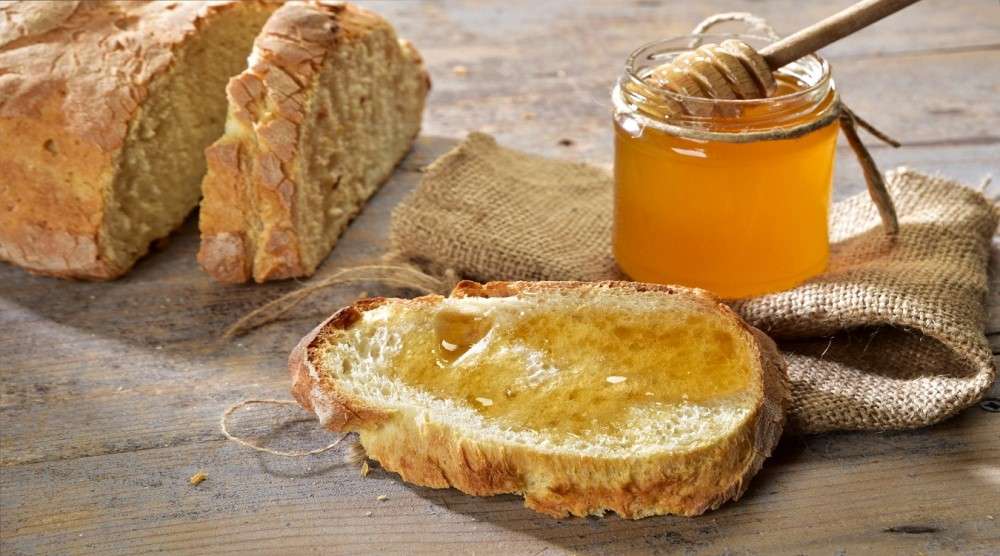
On the savoury side, the traditional pairing of cheese and honey is one of the most Tuscan of all. Official regional product pages for Pecorino del Casentino note that it is traditionally eaten with PDO Tuscan Bread and honey, while the millefiori-honey page explicitly recommends cheese pairings, especially with Pecorino Toscano PDO. This is one of the easiest and most authentic ways to enjoy honey at home: choose the honey according to the cheese. Acacia suits fresher or softer pecorino. Chestnut or marruca are better with aged, firmer, saltier cheeses. Millefiori sits comfortably in the middle.
Modern recipes and simple ways to use Tuscan honey today
If traditional Tuscan recipes show honey’s historical role, modern cooking shows how flexible it still is. The easiest contemporary use is probably a cheeseboard pairing built with intention: fresh pecorino and acacia honey, semi-aged pecorino and millefiori, aged pecorino with chestnut or marruca honey, plus walnuts, pears, and unsalted bread. That approach is rooted in tradition but feels fully current. The same is true of a simple whipped ricotta with chestnut honey and toasted nuts, which works as breakfast, dessert, or aperitivo component. Those combinations are modern in presentation, but completely coherent with Tuscan flavour logic.
Honey also works beautifully in savoury cooking when used with restraint. Millefiori can be whisked into a vinaigrette for salads with fennel, orange, and pecorino. Chestnut honey can be brushed onto roast pork, duck, or grilled radicchio, where its bitterness keeps the glaze from becoming cloying. Acacia honey is excellent in marinades for grilled vegetables because it caramelises gently without overpowering the dish. Marruca honey, with its Mediterranean character, is especially good on goat’s cheese crostini or drizzled over grilled aubergines with herbs. These are not rigidly codified recipes, but they are very much in tune with the flavour profiles described in current Tuscan product material.
For dessert, there are two especially strong directions. The first is to stay close to heritage and make panforte, cavallucci, or a honey-rich spiced loaf inspired by Panficato Gigliese. The second is to use honey in lighter contemporary desserts: grilled peaches with ricotta and acacia honey, panna cotta sweetened partly with millefiori, or Greek yogurt topped with chestnut honey and roasted figs. These work well because they let the honey remain visible as an ingredient rather than dissolving into generic sweetness.
Which honey to choose for which recipe
If you want one practical rule, it is this: choose acacia when you want finesse, chestnut when you want contrast and complexity, millefiori when you want versatility, and the more unusual monoflorals when you want a dish to carry a strong sense of place. Tuscany’s honey culture is so rich precisely because it invites this kind of matching. It is not just about sweetness. It is about botanical character. And that is why honey still matters so much in 2026: it remains one of the clearest edible expressions of the region’s biodiversity, rural traditions, and culinary imagination.