


The History of the Italian Aperitivo: Traditions and Florence Spots You Should Not Miss
More than a pre-dinner drink, aperitivo is an Italian ritual
The Italian aperitivo is often translated simply as a pre-dinner drink, but that definition is too narrow. Aperitivo is a social ritual built around timing, appetite and atmosphere: late afternoon turning into evening, a drink designed to open the palate, and a small table of snacks that turns a pause into a shared moment.
In modern Italian culture, it sits somewhere between hospitality, urban lifestyle and food tradition. Its deeper roots are usually linked to Turin, where the modern story of flavored aperitif wine took shape with the birth of vermouth in 1786, a product that would become one of the foundations of Italian aperitivo culture.
From there, the aperitivo evolved into a broader northern Italian habit and then into a national one. The bitter side of the ritual gained force in the nineteenth century with Campari, whose history begins in 1860, while the lighter, brighter side of the tradition was strengthened by Aperol, launched in 1919 after years of experimentation by the Barbieri brothers. Those two developments matter because they still define the way Italians drink before dinner today: somewhere between vermouth, bitter, soda, sparkling wine and low-key conviviality.
Florence has a special place in aperitivo history thanks to the Negroni
If Turin gave Italy vermouth and the modern aperitivo framework, Florence gave the ritual one of its most famous cocktails: the Negroni. The standard story places its birth in 1919 at Caffè Casoni, where Count Camillo Negroni, with bartender Fosco Scarselli, is said to have strengthened his usual Americano by replacing soda with gin. That one gesture changed cocktail history and gave Florence a permanent place in the global aperitivo imagination.
That is one reason Florence is such a good city in which to understand aperitivo. Here, the ritual is not only imported from elsewhere; it is also part of local identity. You can still feel that in the city’s drink culture today, where classic cocktails, historic cafés, wine bars, rooftop terraces and neighborhood enoteche all coexist. Florence does not offer just one version of aperitivo. It offers several, each tied to a different mood of the city.
What Italians usually drink at aperitivo time
The most classic aperitivo drinks in Italy still revolve around a few families. First comes vermouth, especially in more traditional settings. Then come bitter-based cocktails such as the Americano and the Negroni, both built on the balance between sweet vermouth and bitter liqueur. Finally, there is the now-global Aperol Spritz, usually served with sparkling wine and soda, which has become one of the most recognizable low-alcohol aperitivo drinks in the world.
In Florence, wine also remains central to aperitivo culture. Not every aperitivo is cocktail-led. In many places, especially more traditional or food-oriented ones, a glass of Chianti, a crisp white, or sparkling wine is still the preferred way to begin the evening. This is especially true in historic addresses and in places where the snacks matter as much as the drink. That is why a Florentine aperitivo can feel very different depending on where you go: some places are built around classic mixology, others around wine, and others around the view.
What people usually eat with aperitivo
Food is where aperitivo shifts from drink to ritual. The classic Italian format includes olives, chips, nuts, focaccia, crostini, small sandwiches, cured meats and cheeses, but local identity changes the table. In Florence, aperitivo often leans toward Tuscan bread, truffle sandwiches, salumi boards, crostini and small seasonal bites rather than buffet excess. Even where the food is refined, the best places understand that aperitivo should whet the appetite, not replace dinner completely.
That distinction matters because Florence has both styles: the elegant pre-dinner aperitivo and the more generous “apericena” approach. The city is at its best with the first one. The strongest Florentine addresses usually pair a carefully made drink with food that is small, focused and specific to the place. That might mean a truffle panino, a smart plate of appetizers, or a well-built wine-and-snack pairing rather than an anonymous buffet.
The Florence places you should not miss for aperitivo
If you want to start with the most historic side of the city, Caffè Gilli belongs at the top of the list. Founded in 1733, it is widely presented as the oldest historical café in Florence and remains one of the clearest examples of aperitivo as an elegant civic ritual. Sitting in Piazza della Repubblica, it combines historical atmosphere with a contemporary cocktail program, making it ideal for anyone who wants classic Florence with a polished drinks perspective.
Very close by, Caffè Paszkowski is another essential stop. Also in Piazza della Repubblica, it brings together cocktail culture, live music and a long café tradition in a way that feels distinctly Florentine. It is one of the best places to experience aperitivo as a refined urban performance rather than just a quick drink.
For something even more specifically tied to Florentine snacking culture, Procacci 1885 is impossible to ignore. Founded in 1885 in Via de’ Tornabuoni, it remains famous for its truffle-based specialties and wine selection. This is one of the purest examples of a Florentine aperitivo that is small, intense and iconic: a drink, a truffle sandwich, and the feeling that the city’s appetite has been distilled into one address.
If your interest is serious cocktails, Locale Firenze is one of the most important names in the city. Its bar philosophy centers on local products, seasonality and a mix of modern and classic techniques, making it a strong choice for anyone who wants aperitivo to begin with the drink itself. It offers a more contemporary, high-craft reading of Florence than the historic cafés do.
For a more neighborhood-driven, less formal feeling, Caffè Sant’Ambrogio is worth knowing. In Piazza Sant’Ambrogio, it sits in a part of Florence that feels more lived-in and less staged than the grand historic center. It works well for those who prefer a local square, a glass of wine or spritz, and a more relaxed aperitivo rhythm.
Florence is also one of Italy’s best cities for rooftop aperitivo
A completely different side of Florentine aperitivo opens up on the rooftops. La Terrazza, now hosted at the 701 Rooftop Bar on the seventh floor of Gallery Hotel Art, remains one of the city’s most iconic aperitivo views, with Florence’s monuments spread out in front of you. It is a place where the drink and the skyline carry equal weight.
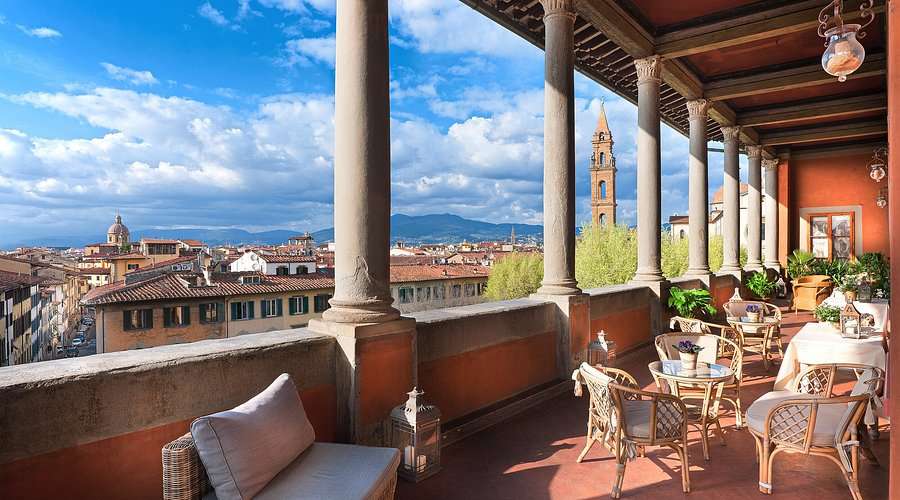
In Piazza Santo Spirito, Loggia Roof Bar at Palazzo Guadagni offers a softer, more intimate panoramic experience, ideal for those who want aperitivo in the Oltrarno with one of the city’s loveliest terrace perspectives.
For a more contemporary rooftop mood, Angel Roofbar & Dining at Hotel Calimala stands out for its multi-terrace setup, signature cocktails and close-up view of the historic center, while The Social Hub Florence Lavagnini offers poolside aperitivos with Duomo views and a younger, more urban energy.
Why Florence is such a good city for understanding aperitivo
What makes Florence special is not only that it gave the world the Negroni. It is that the city still expresses the full range of what aperitivo can be: historic café ritual, truffle-and-wine pause, serious cocktail culture, neighborhood square conviviality and rooftop sunset drinking. In very few cities can you move so easily from Piazza della Repubblica to Via de’ Tornabuoni, from Santo Spirito to a panoramic terrace, and feel that each version is still authentically part of the same tradition.
The history of the Italian aperitivo is a story of appetite, bitterness, elegance and social rhythm. And Florence tells that story unusually well: with vermouth and bitter in the background, the Negroni at the center, and a city full of places where the first drink of the evening still feels like an event rather than a habit.