


Traditional Kosher Dishes That Reached Italy, and Especially Tuscany
How Jewish and kosher food became part of the Italian table
When people speak about kosher cuisine in Italy, they often imagine a single tradition. In reality, Italian Jewish food is the result of many histories layered together: ancient Roman Jewish cooking, Sephardic influences brought by exiles from Spain and Portugal, local market culture, and the strict dietary logic of kashrut, which forbids pork and does not allow meat and cheese to be eaten together in the same meal.
What makes Italy special is that Jewish cooking did not remain sealed off from the surrounding culture. Over centuries, it entered local food habits, reshaped familiar ingredients, and in some cities became part of the regional identity itself.
Tuscany is one of the best places to understand that story. Here, Jewish food traditions did not develop only in one large ghetto city, but across very different settings: Florence, with its historic community and synagogue; Livorno, a port city shaped by Sephardic trade and religious freedom; and Pitigliano, the Maremma town famously known as Little Jerusalem. Together, these places show how traditional kosher dishes and Jewish foodways became part of Italian life and, in particular, of Tuscan culture.
Rome gave Italy some of its most famous Jewish dishes
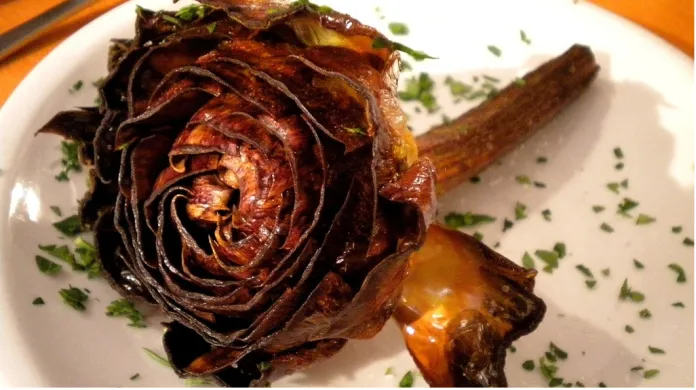
Before moving into Tuscany, it is worth starting with Rome, because Roman Jewish cuisine helped define what many Italians now recognize as classic Jewish food. Dishes such as carciofi alla giudia became iconic far beyond the old Roman ghetto. This deep-fried artichoke, opened like a flower and cooked until crisp and golden, is one of the clearest examples of a kosher-compatible vegetable dish that entered mainstream Italian culinary memory.
Other traditional Roman Jewish foods include fried zucchini flowers, eggplant caponata, potato-and-tuna loaf, and even the braid-shaped bread associated with Shabbat. These dishes matter because they show how Jewish cooking in Italy was never only about religious rules; it was also about transforming local vegetables, fish and pantry staples into a distinct urban cuisine.
That Roman model is important for Tuscany too. It established a pattern that would appear elsewhere in Italy: Jewish communities respected kosher logic, but they cooked with local ingredients, local vegetables and local tastes. In other words, Jewish food in Italy was not imported whole and unchanged. It adapted to place. That is exactly what happened later in Tuscan communities such as Livorno and Pitigliano.
Livorno: where Sephardic influence changed Tuscan food
If there is one Tuscan city where Jewish influence clearly reshaped local cuisine, it is Livorno. The turning point came with the Livornina laws from 1593 onward, when the Medici invited merchants, especially Jews expelled from the Iberian world, to settle in the port with broad rights and protections. Livorno never developed a ghetto in the same way many other Italian cities did, and for centuries its Jewish community became a major cultural and commercial reference point in the western Mediterranean.
Food followed that history.
In Livorno, Jewish and Sephardic presence is tied to the arrival of spices, new ingredients and a more Mediterranean, outward-looking food culture. One of the most striking examples is the city’s tomato-rich fish tradition. The local culinary identity includes dishes such as triglie alla livornese and baccalà alla livornese, and even the famous cacciucco reflects the same tomato-and-spice language. In Livorno, these preparations became deeply local, but their background is linked to the city’s multicultural and Jewish history. At the same time, kosher rules still matter here: a fully kosher version of a fish stew would exclude shellfish, even if the broader city recipe later evolved in another direction.
Another important Livorno example is roschette livornesi. These dry, savory ring-shaped snacks, somewhat similar to large taralli, are explicitly associated with Sephardic Jews and are still recognized as part of Livorno’s street-food culture. They are small, humble and easy to overlook, but they are exactly the kind of food that proves how deeply Jewish habits entered everyday Tuscan eating. When a bakery snack becomes part of the city’s normal food vocabulary, that is cultural integration at its strongest.
Pitigliano: Little Jerusalem and the food of memory
If Livorno tells the story of openness and trade, Pitigliano tells the story of continuity, memory and small-community survival. The town has long been known as Little Jerusalem, and its Jewish quarter remains one of the strongest places in Tuscany to understand how food was woven into religious and communal life. Today, visitors can still see the Museum of Jewish Culture, the Synagogue, and the path leading to the oven where unleavened bread was baked. There are also traces of the kosher butcher, the ritual bath and the kosher cellar, which together show that food was not a side aspect of Jewish life in Pitigliano; it was one of its central structures.
The Forno delle Azzime, the oven for matzo and Passover baking, is especially important. It was used once a year to produce unleavened bread and cakes for Passover and remained in use until 1939. That single place says a great deal about Tuscan Jewish food: kosher cuisine was not only restaurant food or festive cooking, but also ritual baking tied to the calendar, to the home and to the rhythm of the community.
Pitigliano’s best-known Jewish sweet is sfratto, sometimes called sfratto dei goym. It is a stick-shaped pastry filled with honey, walnuts, orange zest and warm spices such as nutmeg. It is now considered one of the signature sweets of Pitigliano and nearby Sorano, but its name and symbolism are directly tied to the history of the Jewish community. Sfratto is one of the clearest examples of a traditional kosher-compatible Jewish preparation that became a local Tuscan specialty in its own right. It is no longer just “Jewish food” in a narrow sense; it is one of the most recognizable sweets of the area.
Florence: the bridge between heritage and present-day kosher culture
Florence occupies a slightly different place in this story. It is less defined by one single dish than by its role as a cultural bridge. The Synagogue and Jewish Museum of Florence remain the heart of the city’s Jewish identity, and the museum presents the long relationship between the Jewish community and Florence itself. That matters because it reminds visitors that Jewish life in Tuscany was not confined to remote villages or port enclaves; it was also part of one of Italy’s great art cities.
Today, Florence also keeps the culinary tradition visible through current kosher dining activity. Places such as Ruth’s Kosher and Ba’Ghetto Firenze show that Jewish and kosher food in Florence is not only historical memory but also a living practice. In that sense, the city works as a gateway: it may not be defined by one legendary dish in the way Rome has carciofi alla giudia or Pitigliano has sfratto, but it is one of the best places to connect Tuscan Jewish heritage with what kosher dining means in the present.
Why these dishes matter beyond religion
What makes these traditional dishes so important is not only that they are kosher or Jewish in origin. It is that they show how food travels through communities and becomes local without losing its identity. In Rome, Jewish artichokes became an Italian classic. In Livorno, Sephardic influence shaped fish cookery and even bakery snacks such as roschette. In Pitigliano, Passover bread and sfratto became inseparable from the town’s identity. In Florence, kosher cooking remains part of the city’s living cultural map.
That is why the history of traditional kosher dishes in Italy, especially in Tuscany, is so compelling. It is not a side note to Italian food culture. It is one of the ways Italy learned to cook with diversity: through adaptation, memory, local ingredients and communities that left permanent marks on the table. And in Tuscany, from Pitigliano to Livorno to Florence, that story is still very much visible and edible.